V for Vendetta: Controversy, Banned Status, and Meaning Explained
You’ve seen the Guy Fawkes mask at a protest, on a hacker’s avatar, or maybe at a Halloween party—but few realize it started as the face of a graphic novel that nearly didn’t get finished. V for Vendetta has lived two lives: first as Alan Moore’s grim 1980s comic about Thatcher-era fascism, then as a 2005 Hollywood blockbuster that swapped anarchy for liberalism.
Original graphic novel publication: 1982–1985 •
Film release year: 2005 •
Film director: James McTeigue •
Screenplay by: The Wachowskis •
Graphic novel writer: Alan Moore •
Film box office: $132 million worldwide
Quick snapshot
- Graphic novel published 1982–1985 in Warrior magazine (Study.com (education platform))
- Film released 2005, directed by James McTeigue (IMDb (movie database))
- Guy Fawkes mask adopted by Anonymous since 2006 (Reactor Magazine (speculative fiction outlet))
- Graphic novel challenged in U.S. school districts, including a Texas district in 2013 (Study.com (education platform))
- Whether the film or graphic novel is more controversial among critics (Reactor Magazine (speculative fiction outlet))
- 1982–1985: Original black-and-white serialization in Warrior magazine (Study.com (education platform))
- 2005: Film adaptation released by Warner Bros. (IMDb (movie database))
- 2006: Mask becomes symbol of Anonymous collective (Reactor Magazine (speculative fiction outlet))
- 2013: Graphic novel removed from a Texas school district library (Study.com (education platform))
- Ongoing debates about surveillance and protest rights keep the story relevant (Reactor Magazine)
- Renewed interest as authoritarian themes mirror modern digital panopticons (Reactor Magazine)
- Alan Moore’s permanent fallout with DC Comics continues to shape the work’s legacy (Reactor Magazine)
What is V for Vendetta actually about?
Plot summary of the graphic novel
Set in a dystopian near-future Britain ruled by the fascist Norsefire Party, the graphic novel follows a mysterious anarchist known only as V. After surviving medical experiments at a concentration camp, V wages a one-man war against the totalitarian state, freeing citizens and destroying government property. He rescues a young woman named Evey Hammond and gradually transforms her into his ideological heir. The story, written by Alan Moore and illustrated by David Lloyd, was serialized in black and white between 1982 and 1985.
Moore’s original work is a philosophical contest between anarchy and fascism—not a simple good-versus-evil story. The state is brutal, but V’s methods are equally questionable, leaving readers to decide which ideology is worse.
Plot summary of the film
The 2005 film adaptation, directed by James McTeigue (film director) and written by the Wachowskis, shifts the setting to 2020s London after a virus pandemic (the “St. Mary’s Virus”) destabilized Europe. Evey Hammond (Natalie Portman) is rescued by V (Hugo Weaving) and becomes his unlikely ally. The film climaxes with V blowing up the Houses of Parliament on November 5, one year after his campaign began.
The catch: the film drops most of the graphic novel’s anarchist philosophy. The script was reworked to align with post-9/11 American concerns about government surveillance and neoconservatism, rather than Moore’s critique of Thatcher-era fascism.
Key differences between the two versions
Three differences, one pattern: the film sanitizes the politics while Hollywood-izing the characters.
| Aspect | Graphic Novel (1982–1985) | Film (2005) |
|---|---|---|
| Political philosophy | Anarchism vs. fascism; no moral winner | Liberalism vs. neoconservatism; clearer hero/villain |
| Valerie character | Lesbian whose persecution is detailed in a letter | Actress whose final film was banned |
| V’s backstory | Survivor of medical experiments at a concentration camp | Victim of government biological testing (same, but less explicit) |
| Evey’s role | Becomes V’s ideological successor through brutal testing | Love interest and moral compass for V |
| Ending | Ambiguous: V dies, Evey continues his campaign of violence | Optimistic: V dies but Evey inspires peaceful revolution |
Why is V for Vendetta so controversial?
The controversy around V for Vendetta isn’t a single flame—it’s a fire with several logs. Political ideology, the glorification of violence, and the real-world adoption of its central symbol all fuel the heat.
Political themes and anarchist message
The story promotes an ideology that challenges the legitimacy of all government. In the graphic novel, V is an unapologetic anarchist who murders and destroys without regret. Critics argue this is dangerous propaganda. Reactor Magazine points out that the original work was explicitly shaped by Thatcher-era politics—a direct critique of the British government’s authoritarian turn. When the Wachowskis adapted it, they softened V’s extremism and swapped in a more palatable liberal message, which satisfied neither side of the political spectrum.
IMDb (movie database) notes the film is set in “the late 2020s” after a pandemic, yet V’s bombings are framed as heroic. Some critics contend the film glorifies terrorism by making a mass murderer the protagonist. The graphic novel is even more stark—V’s violence is graphic and unflinching.
The same work that has been called “dangerous propaganda” by conservatives is also criticized by anarchists for not being radical enough. The middle ground pleases no one—which might be exactly why it endures.
Depiction of terrorism and violence
The film reframes V’s bombings as heroic acts of liberation, but the graphic novel presents violence as morally ambiguous. Critics argue that making a mass murderer the protagonist glorifies terrorism, especially in a post-9/11 context.
Use of the Guy Fawkes mask by real-world protest groups
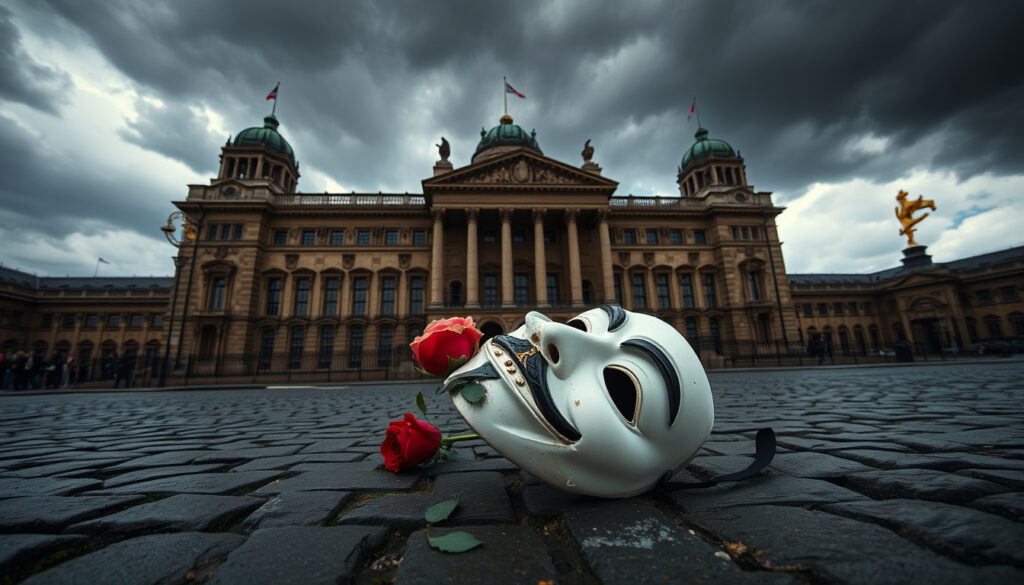
Since 2006, the Guy Fawkes mask has been adopted by Anonymous (hacker collective) as their trademark symbol. The mask then spread to Occupy Wall Street, Arab Spring protests, and Hong Kong demonstrations. This real-world usage has super-charged the controversy: politicians and law enforcement have labeled the mask a symbol of anarchy and criminality, while protesters see it as a symbol of resistance against tyranny.
The mask mirrors the fiction—it’s never clear whether it represents liberation or destruction.
Why is V for Vendetta banned?
Banned in specific schools and countries
Contrary to popular belief, V for Vendetta is not banned nationwide in any country. However, it has been removed from some U.S. school libraries and curricula. In 2013, a school district in Texas removed the graphic novel from library shelves after complaints about its violent content and political themes.
Reasons for censorship
The reasons for challenges include graphic violence, sexual content, and perceived subversive political ideology. The graphic novel’s depiction of sexual violence (specifically against Evey) has been a point of contention. The film was also banned in some countries—for instance, it was not officially released in China for years, though it has since been shown uncensored on CCTV.
What is the #1 banned book of all time?
Comparison to other banned books
Is V for Vendetta the #1 banned book of all time? No. That title typically goes to The Diary of a Young Girl by Anne Frank (for its depiction of homosexuality) or 1984 by George Orwell (for political reasons). V for Vendetta ranks high on “challenged” lists but is not consistently the top. According to the American Library Association, the most challenged book in 2023 was Gender Queer by Maia Kobabe.
The implication: the “banned” label is more myth than reality. The book remains widely available and sells steadily. But the myth itself reveals something—the fear that a story about overthrowing the government might be too dangerous for students to read.
What is the famous line from V for Vendetta?
Most quoted lines from the film
The film version gave us several iconic lines. The most famous is “Remember, remember the 5th of November,” which V recites in a dramatic montage. Another widely shared line: “People should not be afraid of their governments. Governments should be afraid of their people.” Then there’s the philosophical slogan: “Ideas are bulletproof.”
Most quoted lines from the graphic novel
The graphic novel contains different dialogue. V’s introduction is famously cryptic: “I am V. I am what I am.” The book also includes the line: “I have no doubt that you would be a fascinating person,” which the film reuses as a romantic tension point between V and Evey.
Context of the ‘Remember, remember’ speech
The speech references the real Gunpowder Plot of 1605, in which Guy Fawkes attempted to blow up Parliament. In the story, V uses the anniversary as the date for his own revolution. University News Online (student publication) notes that “the core meaning of V for Vendetta is not anarchy or violence but the idea that ‘all it takes for the world to change is an idea.’”
“People should not be afraid of their governments. Governments should be afraid of their people.”
— V (film), IMDb Quotes
“The script was reworked to align with post-9/11 American concerns about government surveillance and neoconservatism, rather than Moore’s critique of Thatcher-era fascism.”
— Reactor Magazine (speculative fiction outlet), Reactor Magazine
What is the most romantic quote from V?
The film version includes the line “I have no doubt that you would be a fascinating person,” which serves as a romantic tension point between V and Evey. This line appears in both the film and the graphic novel, though in the graphic novel it carries less romantic weight.
What is the meaning and symbolism in V for Vendetta?
Symbolism of the Guy Fawkes mask
The mask represents resistance against tyranny. In the original graphic novel, V wears it to hide his scarred face and to become a symbol larger than himself. When the mask is then used by real-world protesters, it gains new meaning as a tool of collective identity. Study.com (education platform) notes that the mask now functions as a political symbol that transcends the story.
Political allegory and anarchism
Both versions are allegories, but they point in different directions. The graphic novel is an allegory of Thatcher-era Britain, where fascism rises from the collapse of democracy. The film is an allegory of post-9/11 America, where surveillance and fear give birth to authoritarianism. Moore’s original is a warning about the left wing gone wrong; the Wachowskis’ film is a warning about the right wing gone wrong.
Symbolism of the letter V
The letter V appears everywhere: V’s name, the clock in his lair, the train he derails, the shape of his knife, the V-sign he flashes. In Roman numerals, V is 5—the 5th of November. It also suggests “victory” and “vendetta.” The pattern is deliberate: every element is tagged with V, turning the story into a kind of visual riddle.
“I am V. I am what I am.”
— V (graphic novel), Study.com
The thread running through it all: the story’s meaning is deliberately unstable. It means different things to conservatives, liberals, anarchists, and protesters. And that instability—not any single political message—is what makes it impossible to pin down, and impossible to ignore.
For a deeper dive into the film’s plot and symbolism, check out V for Vendetta: Juoni, kiistat ja symboliikka on Mediafoorumi.
Frequently asked questions
What is the V for Vendetta mask based on?
The mask is a stylized version of the face of Guy Fawkes, the real-life Catholic conspirator who tried to blow up the British Parliament in 1605. Artist David Lloyd designed it as a “smiling, mocking” disguise.
Who plays V in the film?
Hugo Weaving plays the character of V, though his face is never seen—only his voice and physical performance. James Purefoy was originally cast but left after two weeks.
What is the rating of the V for Vendetta film?
The film is rated R by the MPAA for “strong violence and some language.” It runs 132 minutes.
Is V for Vendetta a true story?
No. It is a fictional story inspired by the historical Gunpowder Plot, but the characters and events are entirely invented.
What does the V stand for in V for Vendetta?
In the story, V does not reveal what the initial stands for—it may stand for “Vendetta” or “Victory,” or it could be a reference to the Roman numeral for 5 (the 5th of November).
How long is the V for Vendetta film?
The theatrical cut is 132 minutes (2 hours 12 minutes).
What is the meaning of the title V for Vendetta?
The title refers to V’s personal vendetta against the Norsefire government that experimented on him and killed his loved ones. It also alludes to “vendetta” as a cycle of revenge.
For readers trying to understand why this story still matters: the tension between Moore’s original vision and the Hollywood adaptation mirrors a bigger cultural battle over how we talk about resistance. In an era of mass surveillance and digital activism, those choices aren’t abstract—they shape how protesters legitimize their cause, how governments frame dissent, and how ordinary people decide what side they’re on.
More related posts