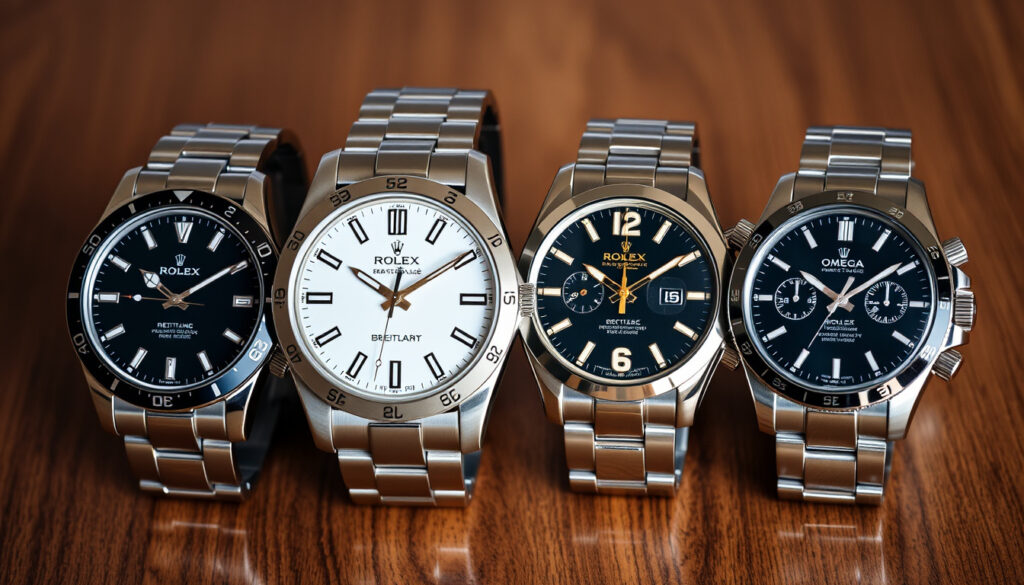
Breitling vs Rolex, Omega, Tag Heuer: Which Is Better
Walk into any watch forum and you’ll see the same debate: Is a Breitling really in the same league as a Rolex? Or is it just a “poor man’s Rolex”? The truth is messier – and more interesting. Breitling carved its own path as a tool-watch pioneer for pilots and divers, and that distinct identity means it holds its own, even if resale numbers tell a different story. Here’s how the four big Swiss brands really stack up, and why the stereotype doesn’t fit.
Here is a quick reference for how the brands compare on key metrics.
| Brand | Tier | Value Retention | Entry Price |
|---|---|---|---|
| Rolex | Tier 1 (Ultra-Luxury) | 60–150% | $8,000+ |
| Omega | Tier 2 (Luxury Sports) | 60–75% | $3,000+ |
| Breitling | Tier 2 (Luxury Sports) | 35–55% | $3,000+ |
| TAG Heuer | Tier 3 (Accessible Luxury) | 25–45% | $1,500+ |
Founded: 1884 •
Headquarters: Grenchen, Switzerland •
Iconic Models: Navitimer, Chronomat, Superocean •
Price Range: $3,000 – $50,000+
Quick snapshot
- Breitling founded in 1884 by Léon Breitling in Saint-Imier, Switzerland (Wikipedia (Swiss watch encyclopedia))
- Breitling invented the modern chronograph pusher in 1915 (Breitling official heritage page)
- Rolex holds Tier 1 status with 60–150% value retention (South Coast Jewellers (luxury watch retailer))
- Whether Omega holds value better than Breitling for all models – varies by reference (Luxury Watches USA (pre-owned specialist))
- Which brand is “better” depends on buyer priorities, not a single metric (Luxury Watches USA (pre-owned specialist))
- Exact origin of the “poor man’s Rolex” phrase is lost to internet lore (internet lore) (Luxury Watches USA (pre-owned specialist))
- 1884 – Léon Breitling opens workshop in Saint-Imier (Wikipedia (Swiss watch encyclopedia))
- 1915 – First independent chronograph pusher patented (Wikipedia (Swiss watch encyclopedia))
- 1952 – Navitimer launched, icon of aviation (Wikipedia (Swiss watch encyclopedia))
- 2009 – In-house caliber B01 introduced (Wikipedia (Swiss watch encyclopedia))
- Breitling continues to expand its tool-watch lineup with new Superocean and Chronomat models (Breitling official heritage page)
- Pre-owned market remains the smartest entry point for value-conscious buyers (Bob’s Watches (pre-owned dealer))
Here is a quick look at the key attributes of Breitling.
| Attribute | Value |
|---|---|
| Founded | 1884 by Léon Breitling in Saint-Imier, Switzerland |
| Known For | Aviator chronographs, Navitimer, Superocean |
| Movement | In-house Caliber B01 (since 2009) among others |
| Target Audience | Pilots, divers, explorers, tool-watch enthusiasts |
Is Breitling as good as Rolex?
Few watch debates run as hot as this one. On paper, both are Swiss, both use quality movements, and both have decades of history. But the comparison lands differently depending on whether you care about prestige, build, or resale value.
Brand Prestige and Recognition
Rolex sits at the top of the luxury pyramid – Tier 1, according to industry analysts South Coast Jewellers (luxury watch retailer). Its crown logo is universally recognized, even by people who don’t follow watches. Breitling, by contrast, is a Tier 2 brand: respected among enthusiasts but less mainstream. That doesn’t make it worse – it makes it different. Breitling’s identity is rooted in aviation and function, not universal luxury. The implication: if you want a watch that signals status to everyone, Rolex wins. If you want a watch that signals a specific passion for aviation and engineering, Breitling wins.
Build Quality and Movement
Both brands build robust watches, but the approach differs. Rolex develops all its movements in-house, with a reputation for accuracy and reliability. Breitling introduced its own in-house caliber B01 in 2009 – a chronograph movement that’s now used across many models. Both are COSC certified, but Breitling takes it further: most of its watches are chronometer-certified, even non-chronographs. Bob’s Watches (pre-owned dealer) notes that Breitling’s accuracy and reliability are generally higher than TAG Heuer, but on par with Omega. The catch: build quality is excellent on both sides, but Rolex’s movements are more technically refined overall.
Resale Value and Investment
This is where the gap widens. Rolex retains 60–150% of retail, depending on model. Breitling retains 35–55%, according to same South Coast Jewellers analysis. That doesn’t mean Breitling is a bad investment – it means you should buy it for the experience, not the flip. The trade-off: if you want a store of value, buy Rolex. If you want a capable tool watch at a lower entry price, Breitling is the smarter pick.
Rolex buyers get a premium on resale but pay a premium upfront. Breitling buyers get a more functional watch with less depreciation risk on the pre-owned market – because the initial price is already lower.
Is Breitling the same level as Omega?
Both are Tier 2 luxury sports brands, but they come from different corporate families and engineering philosophies. Omega is part of the Swatch Group; Breitling was independent until 2017 when CVC Capital Partners acquired it (Wikipedia (Swiss watch encyclopedia)).
Heritage and Innovation
Omega owns the moon landing. Breitling owns the cockpit. That’s a heritage difference that shapes buyer perception. Omega’s Co-Axial escapement, introduced in 1999, was a horological milestone. Breitling’s strength is in chronographs – it invented the modern push-piece chronograph in 1915. Both have deep histories, but they appeal to different nerds. The pattern: Omega is for the space enthusiast, Breitling for the aviator.
Movement Technology: Co-Axial vs. Breitling Calibers
Omega’s Co-Axial movement reduces friction and extends service intervals. Breitling’s B01 is a robust column-wheel chronograph with a vertical clutch. Both are excellent, but the Co-Axial is a more significant technical achievement. Luxury Watches USA (pre-owned analyst) notes that Omega reliably holds value at 60–75% of retail, while Breitling averages 55–70%. The edge goes to Omega, but it’s slim.
Value Retention: Omega vs. Breitling
Omega’s value retention is consistently higher, especially for limited editions and the Speedmaster. Breitling’s Navitimer holds its own – pre-owned models typically fetch 55–65% of original retail. The difference is about 5–10 percentage points. For a buyer, that means Omega is a slightly safer bet if you might sell later, but Breitling offers more watch for the money upfront.
Between Omega and Breitling, the value gap is real but narrow. Choose Omega for technical prestige and marginally better resale. Choose Breitling for a more distinctive tool-watch aesthetic and a lower entry price.
What is better, Tag Heuer or Breitling?
This comparison often comes down to budget and intent. TAG Heuer is Tier 3 (Accessible Luxury), while Breitling is Tier 2. That alone tells you a lot about pricing and positioning.
Design Philosophy
TAG Heuer leans sporty, motorsport-inspired, and more accessible. Breitling is aviation-focused, with larger cases and more complex dials. Both have strong legacies in timing – TAG Heuer with the Monaco and Carrera, Breitling with the Navitimer and Chronomat. The difference is in the details: Breitling’s watches are typically heavier and more tool-like, while TAG Heuer’s are lighter and more fashion-forward.
Pricing and Accessibility
Breitling’s entry price is around $3,000, while TAG Heuer starts around $1,500. That’s a significant gap. South Coast Jewellers places TAG Heuer’s value retention at 25–45%, well below Breitling’s 35–55%. So you get more watch and better resale with Breitling, but you pay for it.
Performance and Durability
Breitling’s COSC certification on most models gives it a clear accuracy edge. TAG Heuer also offers COSC on some models, but not across the board. In terms of water resistance and robustness, Breitling’s Superocean and Avenger lines are built for real diving and flying, while TAG Heuer’s Aquaracer is a capable but less specialized diver. The trade-off: if you want a watch that can handle serious conditions, Breitling is the better tool. If you want a stylish everyday watch for less money, TAG Heuer works well.
Is Breitling worth the money?
This is the core question for anyone considering a Breitling. The answer depends on what you value.
What You Get for the Price
You get a Swiss-made, COSC-certified chronometer with a robust movement, often with in-house manufacture (B01). The build quality is excellent – solid cases, crisp bezels, and reliable movements. Breitling’s design language is polarizing: some love the bold, aviation-inspired look; others find it too busy. But the engineering is top-tier.
Depreciation and Used Market
Breitling depreciates more than Rolex but less than TAG Heuer. Bob’s Watches confirms that Breitling generally holds value better than TAG Heuer, though both lag far behind Rolex. The best value is found on the pre-owned market, where you can get a Navitimer or Chronomat for 35–45% less than retail. For a buyer who accepts that watches are not investments, Breitling offers strong value per dollar.
Alternatives in the Same Price Bracket
At $3,000–$6,000, the alternatives are Tudor (often called the “poor man’s Rolex”), Longines, and Omega (pre-owned). Tudor is a direct competitor with similar value retention. Omega’s pre-owned prices are higher. Breitling stands out for its aviation heritage and chronograph focus. The catch: if you care about brand prestige above all, consider Rolex or Omega. If you want a unique, functional tool watch, Breitling is a compelling choice. For a broader perspective on luxury watch hierarchy, read our Men’s AP Watch: Is Audemars Piguet Higher End Than Rolex comparison.
For a buyer in the $3,000–$6,000 range, Breitling offers the most distinct personality among its peers. The Navitimer is not just a watch – it’s a conversation starter, a piece of aviation history, and a genuine chronograph tool.
What kind of person wears a Breitling?
Breitling’s marketing has always targeted aviators, divers, and explorers. But the actual buyer is often someone who values function over fashion, and who appreciates the brand’s under-the-radar status.
Professional Pilots and Adventurers
Breitling has strong ties to aviation. The Navitimer was designed for pilots, with its slide rule bezel for flight calculations. The brand is still a sponsor of the Breitling Jet Team. Many real pilots wear Breitling, and the brand’s tool-watch DNA appeals to anyone who needs a reliable instrument, not just a status symbol.
Watch Enthusiasts and Collectors
Among enthusiasts, Breitling is respected for its chronograph expertise and independent spirit. The B01 movement is considered a benchmark for column-wheel chronographs. Collectors often seek out vintage Navitimers and the rarer “Panda” dials. The brand is seen as an “insider’s choice” – a badge of knowledge, not just wealth.
Status-Conscious Buyers
Let’s be honest: some people buy Breitling because it’s a luxury Swiss watch that costs less than a Rolex. They want the cachet of a high-end watch without the premium. The “poor man’s Rolex” label is unfair, but it reveals a real segment of buyers. Breitling works for them because it’s recognizable but not as common as a Submariner. The paradox: the brand’s own identity is strong enough that true enthusiasts don’t see it as a substitute – it’s a different thing entirely.
What is poor man’s Rolex?
The phrase “poor man’s Rolex” is a loaded term, often used dismissively. It’s worth unpacking, because it tells us a lot about watch culture and brand perception.
Origins of the Phrase
The exact origin is unclear, but the term likely emerged from Rolex’s overwhelming market dominance. Any watch that looks like a Rolex but costs less risks being labeled a substitute. The phrase is most commonly applied to Tudor, which is actually Rolex’s sister brand (both owned by Hans Wilsdorf Foundation). Other candidates include Longines, Oris, and yes, sometimes Breitling.
Whether the Label Fits Breitling
It doesn’t – not really. Breitling is a distinct brand with its own history, heritage, and design philosophy. It doesn’t imitate Rolex. The Navitimer, Chronomat, and Superocean have no direct Rolex equivalents. Calling Breitling a “poor man’s Rolex” is like calling Porsche a “poor man’s Ferrari” – it ignores completely different engineering and marketing approaches. Crown & Caliber (watch marketplace) notes that Breitling’s target audience is more niche than Rolex, precisely because it doesn’t chase universal appeal.
Better Value Alternatives
If you’re looking for a Rolex-like experience at a lower price, Tudor is the obvious choice – it uses Rolex-adjacent technology and design. Longines offers classic elegance. Omega (pre-owned) gives you a more prestigious name. But if you want a watch that stands on its own, Breitling is a better buy than any of these “substitutes” because it offers something genuinely different: a purpose-built tool watch with a rich aviation heritage. If you’re looking at accessories, our Leather Watch Guide: Best Brands, Care & Buying Tips offers practical advice.
The “poor man’s Rolex” label actually hurts Rolex more than Breitling – it implies Rolex’s status is so dominant that any other watch is a consolation prize. The data shows Breitling has its own loyal following, and its value retention, while lower, is still respectable for a non-Rolex luxury watch.
Pros & Cons of Breitling
Upsides
- Distinct tool-watch heritage with genuine aviation and diving credentials
- Most models are COSC-certified chronometers
- In-house B01 movement is a robust, modern chronograph
- Strong pre-owned market with good value for money
- Unique design that stands out from Rolex homogeneity
Downsides
- Lower brand prestige than Rolex and Omega
- Resale value lags behind Rolex and Omega
- Design polarizing – some find it bulky or busy
- Depreciation steeper than top-tier competitors
- Limited service network compared to Swatch Group brands
prestigetime.com, watchfinder.com, reddit.com, youtube.com, watchuseek.com
For a detailed breakdown of how these two Swiss giants stack up, check out this Breitling vs. Rolex comparison covering prices and quality.
Frequently asked questions
Are Breitling watches good for diving?
Yes – the Superocean line is specifically designed for diving, with water resistance up to 500 meters and a unidirectional bezel. Many models are ISO 6425 compliant.
How often does a Breitling need servicing?
Breitling recommends service every 3–5 years, depending on usage. The in-house B01 movement typically requires a full service every 5 years.
Does Breitling offer warranties on pre-owned watches?
Breitling’s official warranty applies only to new watches from authorized dealers. Pre-owned watches from resellers like Bob’s Watches or Crown & Caliber come with their own warranties, typically 1–2 years.
Which Breitling model is best for everyday wear?
The Chronomat 42 is a versatile choice – it’s comfortable, moderately sized, and works for both casual and formal settings. The Navitimer is more distinctive but larger.
Is Breitling a good investment watch?
Not in the way Rolex is. Breitling’s value retention of 35–55% is moderate. Buy it for enjoyment, not as an investment. The best investment Breitling is the Navitimer 806 1959 Re-Edition, which has appreciated in the pre-owned market.
How does Breitling compare to Tudor in value?
Tudor and Breitling are close competitors. Tudor retains value slightly better (40–60% vs. 35–55%), but both are solid Tier 2 brands. Tudor benefits from association with Rolex; Breitling benefits from a more unique identity.
For the Irish buyer looking at Breitling, the choice is clear: buy pre-owned, focus on the Navitimer or Chronomat, and accept that you’re paying for engineering, not investment returns. The alternative is Tudor – but then you’d be buying a “poor man’s Rolex” for real.
More related posts
 Cast Of The Naked Gun 2025
 Harry Hamlin: Relationships, Marriage to Lisa Rinna, and Family
 2024 Cannes Film Festival: Winners, Lineup, Key Moments
 Sex Lives Of College Girls Cast
 Powerless Series Reading Order and Book Count
 Cast Of The Lincoln Lawyer Tv Series
 Cast Of Mean Girls 2024
 Cast Of Red One Film