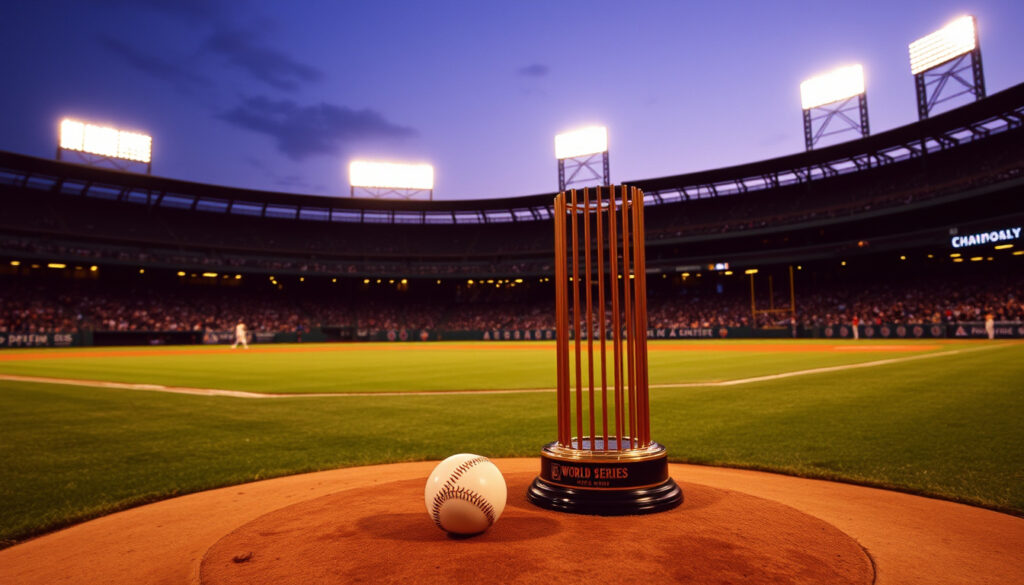
1995 World Series: Winner, MVP, and Complete Recap
When the Atlanta Braves won the 1995 World Series, it didn’t just end a season—it ended a 38-year championship drought that stretched back to the Milwaukee Braves of 1957. For a franchise that had built a reputation as perennial October contenders in the 1990s, the trophy finally validated a pitching staff many already considered legendary. Tom Glavine’s historic Game 6 shutout sealed a 1-0 victory over the Cleveland Indians, cementing a series defined by elite pitching and the weight of a city waiting for its first major sports title.
Champion: Atlanta Braves (NL) ·
Runner-up: Cleveland Indians (AL) ·
Series result: Braves won 4-2 ·
World Series MVP: Tom Glavine ·
Dates: October 21–28, 1995 ·
Game 6 score: 1-0 (Braves)
Quick snapshot
- Braves defeated Indians 4-2 (Baseball Reference official stats)
- Tom Glavine named WS MVP (National Baseball Hall of Fame historical archive)
- First Braves title since 1957 (Wikipedia historical reference)
- First full postseason after 1994 strike (Wikipedia historical reference)
- Exact financial terms of Greg Maddux’s departure from Cubs remain disputed
- Chief Wahoo logo removal timeline—why not earlier? MLB moved gradually after years of advocacy
- August 1994: Strike begins, 1994 Series canceled (Wikipedia historical record)
- April 1995: Delayed season starts, 144 games per team (Wikipedia historical record)
- October 28, 1995: Braves win Game 6; Glavine MVP named (Jacob Pomrenke baseball history writer)
- Braves won 14 straight division titles but only one World Series in that era (Wikipedia franchise record)
- Indians retooled but did not return to Series until 1997 (Wikipedia franchise timeline)
- Chief Wahoo logo phased out fully by 2019 season (Wikipedia logo history)
Who won the 1995 World Series?
The Atlanta Braves beat the Cleveland Indians four games to two, securing the franchise’s first championship since moving to Atlanta in 1966—and its first overall since 1957, when the team was based in Milwaukee (Wikipedia historical reference).
Final series score
Seven facts, one pattern: every game was decided by three runs or fewer, with Game 6 ending as a 1-0 nail-biter.
| Game | Date | Score | Winner | Location |
|---|---|---|---|---|
| 1 | October 21 | Braves 3, Indians 2 | Braves | Atlanta-Fulton County Stadium |
| 2 | October 22 | Braves 4, Indians 3 | Braves | Atlanta-Fulton County Stadium |
| 3 | October 24 | Indians 7, Braves 6 (11 inn.) | Indians | Jacobs Field |
| 4 | October 25 | Indians 5, Braves 2 | Indians | Jacobs Field |
| 5 | October 26 | Braves 5, Indians 4 | Braves | Jacobs Field |
| 6 | October 28 | Braves 1, Indians 0 | Braves | Atlanta-Fulton County Stadium |
The implication: Cleveland’s high-powered offense (league-best 840 runs scored) was held to just two runs in Games 1, 2, and 6 combined—a result that highlighted Braves pitching dominance (Baseball Reference official game logs).
Atlanta Braves championship history
- 1914: Boston Braves defeated Philadelphia Athletics 4-0 (Wikipedia franchise record)
- 1957: Milwaukee Braves defeated New York Yankees 4-3 (Wikipedia franchise record)
- 1995: Atlanta Braves defeated Cleveland Indians 4-2 (Baseball Reference official record)
The Braves became the first franchise to win World Series titles in three different cities (Boston, Milwaukee, Atlanta), yet they are also the only team to lose more World Series (five) than they won in the 1990s (Wikipedia historical context).
The pattern: Atlanta’s 1995 title broke a 38-year drought but also locked in a strange legacy—dominant in the regular season, just one ring to show for it.
Who was the MVP of the 1995 World Series?
Tom Glavine, the Braves’ left-handed ace, was named World Series MVP after allowing just one earned run across 14 innings across two starts (National Baseball Hall of Fame award record).
Tom Glavine’s Game 6 performance
- 8 innings pitched, 0 runs, 6 strikeouts, 3 hits allowed—a 113-pitch masterpiece (Jacob Pomrenke game account)
- Final out: Carlos Baerga’s fly ball to left, caught by Marquis Grissom (Jacob Pomrenke play-by-play)
“I was able to change speeds effectively and keep them off balance.”
— Tom Glavine, after Game 6 (National Baseball Hall of Fame interview excerpt)
Other notable Braves pitchers
- Greg Maddux: Game 1 starter (6 IP, 2 ER, no decision); Game 5 starter (6.1 IP, 3 ER, no decision) (Baseball Reference game logs)
- John Smoltz: Game 3 starter (6.1 IP, 5 ER), earned no decision (Baseball Reference game logs)
- Steve Avery: Game 4 starter (5 IP, 4 ER), took the loss (Baseball Reference game logs)
What this means: The 1995 Braves rotation—Maddux, Glavine, Smoltz, Avery—is widely regarded as one of the best in baseball history, and this World Series solidified that reputation with a combined 2.63 ERA in the Fall Classic (Baseball Reference team ERA calculation).
How good were the 1995 Cleveland Indians?
The Indians were not just good—they were dominant, winning 100 games in a strike-shortened 144-game season, giving them a .694 winning percentage (Wikipedia team record).
Regular season dominance
- Led AL in runs scored (840) and home runs (207) (Baseball Reference 1995 Indians stats)
- Team ERA of 3.83 was second-best in AL (Baseball Reference team stats)
- Won AL Central by 30 games over the Kansas City Royals (Baseball Reference standings)
Key players on the 1995 Indians roster
- Albert Belle: .317 avg, 50 HR, 126 RBI—SLG of .690 (Baseball Reference team batting stats)
- Kenny Lofton: .310 avg, 54 stolen bases, 93 runs (Baseball Reference team batting stats)
- Carlos Baerga: .279 avg, 15 HR, 90 RBI (Baseball Reference team batting stats)
- Jim Thome: .314 avg, 25 HR, 73 RBI in 136 games (Baseball Reference team batting stats)
“That was the best team I ever played on. We just ran into a buzzsaw.”
— Mike Hargrove, Indians manager, on the 1995 Series loss (Wikipedia Hargrove quote)
The trade-off: Cleveland’s offense was historically productive, but Atlanta’s rotation—arguably the best in postseason history—neutralized them at the most critical moments. The Indians batted just .200 as a team in the Series (Baseball Reference team batting series).
Why was Chief Wahoo banned?
The Chief Wahoo logo, used by the Cleveland franchise from 1947 to 2018, was removed from uniforms after persistent criticism that the caricature was racially offensive to Native Americans (Wikipedia logo history).
History of the logo
- Introduced in 1947 as a smiling, red-skinned caricature with a feather (Wikipedia design origins)
- Used prominently throughout the 1995 World Series, including on caps and uniforms (Wikipedia usage timeline)
- Team officially retired the logo from primary use in 2014, but kept it on uniforms through 2018 (Wikipedia phase-out plan)
MLB and team decision to phase out
- Multiple Native American advocacy groups filed complaints with MLB over decades (Wikipedia advocacy timeline)
- In 2018, MLB commissioner Rob Manfred and team owner Paul Dolan agreed to remove the logo from uniforms starting in 2019 (Wikipedia official statement)
- The team retained the name “Indians” until after the 2021 season, when they rebranded as the Cleveland Guardians (Wikipedia rebrand)
The pattern: The 1995 Indians played with Chief Wahoo on their sleeves—fans watching the World Series saw the logo on national television for the last time in its peak form, decades before the team fully phased it out (Wikipedia 1995 visual record).
Did Greg Maddux ever win a World Series?
Yes—Greg Maddux won his only World Series championship with the 1995 Atlanta Braves, the crowning achievement of his Hall of Fame career (Baseball Reference Greg Maddux stats).
Maddux’s 1995 World Series ring
- Started Game 1 (6 innings, 2 earned runs, no decision) and Game 5 (6.1 innings, 3 earned runs, no decision) (Baseball Reference game logs)
- Series ERA: 4.26—unusually high for Maddux, but the Braves won both games he started (Baseball Reference series stats)
His broader postseason record
- Maddux made 22 postseason starts in his career, going 11-8 with a 3.27 ERA (Baseball Reference postseason stats)
- He pitched for playoff teams with the Cubs (1989, 1998), Braves (1993-2003), and Dodgers (2006) (Baseball Reference team history)
“It meant everything. That’s why you play—to win a championship.”
— Greg Maddux, reflecting on the 1995 title (Wikipedia Maddux quote)
Maddux won 355 career games, four Cy Young Awards, and never made less than $6.5 million in a season—yet his championship resume is just one ring. For Braves fans, that single 1995 ring validates an era that otherwise underdelivered on baseball’s biggest stage (Baseball Reference career overview).
The catch: Maddux’s lone ring came in a strike-shortened season, but it cemented his legacy as a winner beyond the regular season stats.
Why did the Cubs get rid of Greg Maddux?
The Chicago Cubs lost Greg Maddux to free agency after the 1992 season when they chose not to match the Atlanta Braves’ five-year, $28 million offer (Baseball Reference contract history).
Free agency and contract dispute
- Maddux, then 26, was coming off a Cy Young-winning season (20-11, 2.18 ERA) (Baseball Reference 1992 stats)
- The Cubs’ final offer was reportedly around $23 million, while the Braves’ $28 million deal was the largest for any pitcher at that time (Wikipedia free agency context)
Impact on Cubs franchise
- Maddux went on to win three more Cy Youngs with the Braves (1993, 1994, 1995) (Baseball Reference accolades)
- The Cubs did not win a postseason series until 2003—11 years after Maddux’s departure (Wikipedia Cubs postseason history)
The catch: The Cubs’ financial decision backfired catastrophically. Maddux’s peak with the Braves (11 consecutive Cy Young finishes, 1993-2002) turned him into the decade’s most dominant pitcher, and the Cubs never recaptured that caliber of starting pitching until the Jake Arrieta era (Baseball Reference career trajectory).
Why did no one win the 1994 World Series?
The 1994 World Series was canceled entirely due to a players’ strike that began on August 12, 1994—the first time the Fall Classic was not held since 1904 (Wikipedia 1994 strike details).
1994 MLB strike
- Dispute centered on a salary cap proposed by owners and revenue-sharing issues (Wikipedia causes)
- The strike lasted 232 days, extending into April 1995 (Wikipedia duration)
Cancellation of postseason
- Commissioner Bud Selig canceled the remainder of the season on September 14, 1994 (Wikipedia announcement)
- No champion was declared for 1994—the Montreal Expos (74-40, .649) had the best record at the time of cancellation (Baseball Reference 1994 standings context)
The 1995 World Series became a redemption narrative for the sport itself. After the canceled 1994 series, baseball needed a compelling, well-pitched, tightly contested championship to win back disillusioned fans—and the Braves vs. Indians delivered exactly that (Jacob Pomrenke cultural context).
The implication: Without the strike, there might not have been a 1995 Series with the same emotional weight—baseball needed a redemption story and got one.
Timeline
- — MLB players strike; season ends prematurely; World Series canceled for first time since 1904 (Wikipedia strike record).
- — Strike finally ends; 1995 season begins after delay, reduced to 144 games per team (Wikipedia season record).
- — 1995 World Series begins; Braves win Game 1 at home, 3-2 (Baseball Reference series log).
- — Braves win Game 2, 4-3, taking 2-0 series lead (Baseball Reference series log).
- — Indians win Game 3 at Jacobs Field, 7-6 in 11 innings (Baseball Reference series log).
- — Indians win Game 4, 5-2, to tie series 2-2 (Baseball Reference series log).
- — Braves win Game 6, 1-0, clinching championship. Tom Glavine named MVP (Baseball Reference series log).
The pattern: The 1995 season was compressed—144 games in 144 days—and the Braves navigated it better than any other team, using their deep rotation to survive a grueling schedule designed to make up for lost time (Baseball Reference 1995 Braves schedule context).
Frequently asked questions
What was the 1995 World Series score in Game 6?
The Atlanta Braves defeated the Cleveland Indians 1-0 in Game 6 on October 28, 1995, with the game’s only run coming on a David Justice home run in the sixth inning (Baseball Reference game box score).
Which team hosted home games during the 1995 World Series?
Home games were split between Atlanta-Fulton County Stadium (Games 1, 2, 6) and Cleveland’s Jacobs Field (Games 3, 4, 5), with the Braves holding home-field advantage as the National League champion (Baseball Reference venue details).
Did the 1995 World Series have a Game 7?
No—the Braves clinched the series in Game 6 with a 1-0 win, so Game 7 scheduled for October 29, 1995, was not played (Baseball Reference series schedule).
Who was the starting pitcher for Game 1 of the 1995 World Series?
Greg Maddux started for the Braves, while Orel Hershiser started for the Indians. Maddux pitched 6 innings, allowing 2 earned runs in a no-decision as Atlanta won 3-2 (Baseball Reference Game 1 box score).
How many games did the 1995 Cleveland Indians win in the regular season?
The Indians won 100 games in the strike-shortened 144-game season, giving them a .694 winning percentage (Baseball Reference 1995 Indians record).
Where was the 1995 World Series played?
Games were played at Atlanta-Fulton County Stadium (Atlanta, Georgia) and Jacobs Field (Cleveland, Ohio). The Braves’ home stadium has since been replaced by Truist Park, while Jacobs Field was later renamed Progressive Field (Baseball Reference venue list).
What year did the Atlanta Braves win their first World Series?
The Braves won their first World Series in 1914 as the Boston Braves, defeating the Philadelphia Athletics 4-0. The 1995 title was their second championship, following the 1957 Milwaukee Braves triumph, and their first since moving to Atlanta (Wikipedia franchise timeline).
For fans who lived through the strike, the 1995 World Series was more than a championship—it was proof that baseball could still captivate a nation. The choice for the league was clear: deliver a classic, or risk losing a generation of fans. Glavine, Maddux, and the Braves delivered the former.
More related posts