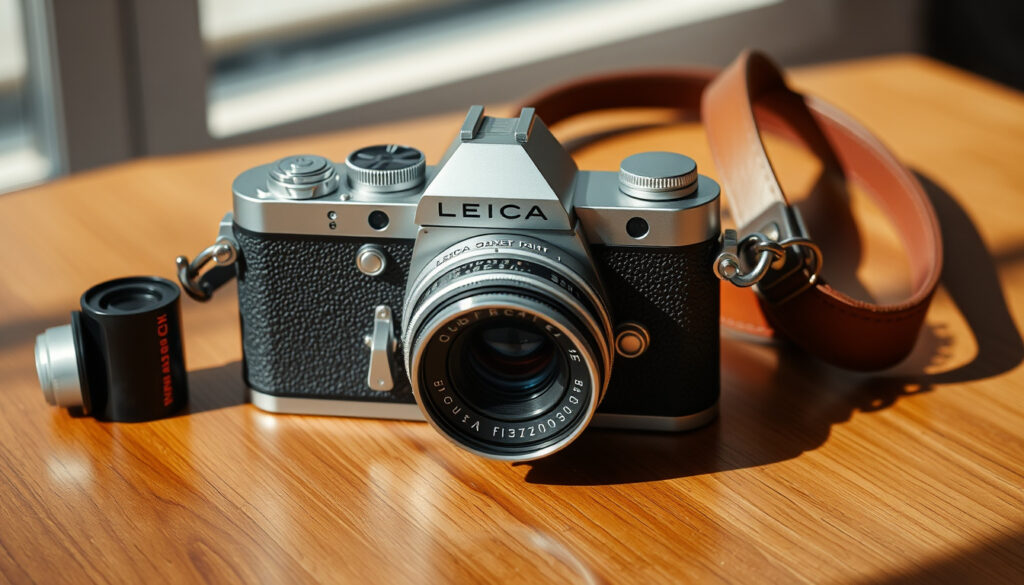
Leica Film Camera Buyer’s Guide: Worth the Investment
There’s a quiet magic in loading a roll of film into a Leica M. The distinct click of the shutter, the weight of brass and magnesium in your hands—it’s a ritual that has survived a century of technological change. If you’re reading this, you’ve likely wondered whether a Leica film camera is worth the investment, or which model makes sense for you. This guide cuts through the nostalgia and hype to give you the facts, the prices, and the trade-offs, based on what’s actually available new and used in 2024.
Founded: 1913 ⋅
Current film models: 3 (M6, M-A, MP) ⋅
Price range (new): $2,500 – $8,000 ⋅
Average used M6 price: $3,000 – $4,500 ⋅
Film camera production status: Active (since 2022)
Quick snapshot
- The most iconic Leica film camera (MrLeica (enthusiast expert))
- Reintroduced in 2022 (MrLeica) (MrLeica (enthusiast expert))
- Built-in light meter (MrLeica) (MrLeica (enthusiast expert))
- Interchangeable M-mount lenses (Leica Camera AG (official manufacturer))
- Price new: ~$5,000 (MrLeica (enthusiast expert))
- Fully mechanical, no battery required (MrLeica)
- Same body as MP but simpler
- Classic design, no light meter (MrLeica)
- Price new: ~$4,500
- Modern take on the M series (MrLeica)
- Built-in light meter (MrLeica)
- Classic styling with improved viewfinder (MrLeica)
- Price new: ~$5,500
- Models like Leica Minilux, CM, Z2X
- Compact and easy to use
- Fixed or zoom lens
- Prices vary widely used
Three current Leica film M bodies, one clear pattern: the trade-off between having a light meter and going fully mechanical. Here’s how they compare on essential specs.
| Feature | Leica M6 (2022) | Leica M-A | Leica MP |
|---|---|---|---|
| Built-in light meter | Yes | No | Yes |
| Battery required | Yes (for meter) | No | Yes (for meter) |
| Viewfinder magnification | 0.72x | 0.72x | 0.72x or 0.85x |
| Red dot branding | Yes | No | No |
| Price new (approx.) | $5,000 | $4,500 | $5,500 |
| Production start | 2022 | 2014 | 2003 |
The implication: if you want a meter and a modern warranty, the M6 or MP are your picks. If you love the idea of a camera that needs no electricity and will outlast you, the M-A is the one.
Is it worth buying a Leica film camera?
Pros and cons of Leica film cameras
Upsides
- Outstanding build quality – brass and magnesium construction (MrLeica)
- Leica M lenses are among the sharpest ever made
- Resale value holds strongly – often increases over time
- Mechanical reliability – many 50-year-old M3s still work perfectly
Downsides
- Very expensive – new bodies start at $4,500
- Rangefinder focusing takes practice
- Limited to 35mm film – no digital option in same body
- Parts and service for older models can be hard to find
The trade-off: you pay a premium for precision engineering and a community that values longevity. For many, that’s worth the price.
Alternatives to Leica film cameras
If the Leica M price tag gives you pause, there are excellent alternatives. James at Casual Photophile recommends five cameras for shooters on a budget (Casual Photophile (photography gear review site)). Among them: the Nikon FM2, Canon AE-1, and the Olympus OM-1. None have the same rangefinder feel, but they deliver great images for a fraction of the cost.
Another popular alternative is Fujifilm’s film cameras, like the Fujica GW690 or the Fujifilm Klasse. These are rangefinders too, but with fixed lenses and lower price points. The comparison between Leica and Fujifilm is a whole separate debate – we’ll get to that below.
Long-term value and resale
Leica film cameras are unusual in that they often appreciate in value. A used Leica M6 that cost $2,000 in 2010 can now fetch $3,000–$4,500 (Reddit (Leica community)). The M3, introduced in 1954, still sells for $1,000–$2,000 in good condition. This is a rare trait among consumer electronics – most cameras lose value the moment you buy them.
Does Leica still make a film camera?
Current Leica film camera models
Yes, Leica currently produces three film cameras: the M6 (reintroduced in 2022), the M-A (since 2014), and the MP (since 2003). All are M-mount rangefinders made in Wetzlar, Germany (MrLeica). The M6 re-issue is the most talked-about, with its classic red dot and built-in light meter. The M-A is the purist’s choice – no meter, no battery, just film and mechanics. The MP is the modern classic, with a light meter and improved viewfinder.
According to the official Leica website, the M6 is described as “a timeless icon reborn for a new generation of photographers” (Leica Camera AG).
Discontinued models still available used
Leica has discontinued many film cameras over the years, but they remain popular on the used market. The original M6 (1984–1998) is still widely available. The M3 (1954–1966) and M2 (1957–1968) are legendary for their build and viewfinder quality. The M4 (1967–1975) is also highly regarded – some collectors seek out specific serial number ranges, like the 1,2xx,xxx range, considered the best M4s (Reddit).
Discontinued point-and-shoot models like the Leica Minilux, CM, and Z2X are also available used, but their prices have risen sharply as demand for compact film cameras has grown.
Production history and future outlook
Leica’s film production history is long and storied. The Ur-Leica prototype was created in 1913 by Oskar Barnack (Leica Camera AG). The first mass-produced 35mm camera, the Leica I, launched in 1925. The M3 in 1954 established the M-mount system still used today. The M6 launched in 1984 and became the best-selling M-series film camera. Production ended in 1998, but in 2022 Leica surprised everyone by bringing it back.
What’s next? Leica hasn’t announced any new film models, but the reintroduction of the M6 suggests strong demand. Whether they will introduce a new model or a limited edition remains unclear.
How much does a Leica film camera cost?
New Leica film camera prices
Buying new from Leica or authorized dealers, expect to pay:
- Leica M6 (2022): ~$5,000
- Leica M-A: ~$4,500
- Leica MP: ~$5,500
These prices are for the body only. Lenses add significant cost – a new 50mm f/2 Summicron is about $2,500. A complete kit with a body and lens typically runs $7,000–$8,000.
Prices are from official Leica retail and verified by MrLeica (MrLeica).
Used Leica film camera price ranges
Used prices vary widely depending on condition, rarity, and whether the camera has been serviced. Rough ranges:
- Leica M3: $1,000–$2,000
- Leica M2: $800–$1,800
- Leica M4: $1,200–$2,500
- Leica M6 (original, 1984–1998): $2,500–$4,500
- Leica M6 (2022 re-issue): $4,000–$5,000 (if bought used)
- Leica MP: $3,000–$5,000
- Leica M-A: $3,500–$4,500
Point-and-shoot models like the Minilux range from $400 to $1,500 depending on condition and lens.
Factors affecting cost
Condition is king. A camera that has been recently serviced by a specialist (like Youxin Ye or DAG Camera) will command a premium. Rarity also matters – limited editions, special engravings, or rare lens combinations can double prices. The lens itself is often the most expensive part; a 50mm f/1.4 Summilux can cost $2,000–$4,000 used.
What this means: if you’re budget-conscious, consider buying a body and a third-party lens (like Voigtländer) to start. You can upgrade the lens later.
Which Leica film camera is the best?
Best for beginners
For someone new to Leica film, the M6 (either original or re-issue) is the most forgiving. Its built-in light meter takes the guesswork out of exposure, and the 0.72x viewfinder is bright and easy to use. The M6 is the most popular Leica film camera for a reason – it balances usability with the classic Leica experience (MrLeica).
If you want a lighter option, consider a Leica CL or Minolta CLE – these are smaller, cheaper M-mount rangefinders with meters, but they’re not made by Leica (they were co-developed with Minolta). Used prices are $600–$1,200.
Best for professionals
Professionals who shoot film often prefer the MP or the M-A. The MP offers a light meter and a 0.85x viewfinder option, which is excellent for precision focusing with fast lenses (MrLeica). The M-A is the choice for those who want a camera that will never fail due to dead batteries – it’s fully mechanical.
Another contender: the Leica M3 is still used by many pros for its legendary viewfinder (0.91x magnification) and smooth operation. The M3 is described as “a complete sneaker” of a film camera choice in 2025, offering absolute joy to shoot (Moment (photography gear retailer)).
Best value for money
The best value in Leica film is arguably the M3. At $1,000–$2,000, it’s a fraction of the price of a new M6, and its build quality is arguably higher. The catch: no light meter, so you’ll need to learn exposure or use an external meter. Also, it only has 50mm, 90mm, and 135mm frame lines – no 35mm lines, which is a dealbreaker for some.
The M2 is another value pick, with 35mm frame lines and a slightly lower price than the M3.
Is Fujifilm or Leica better?
Comparison of build and design philosophy
Leica and Fujifilm take very different approaches. Leica builds rangefinders with mechanical precision, using brass and magnesium. Fujifilm produces both rangefinder-style digital cameras (like the X-Pro series) and film cameras (like the Fujica series). The Fujifilm X100 series, for example, is digital with a fixed lens and an electronic viewfinder, while Leica M is purely analog and optical.
If you want a film camera, Fujifilm’s film offerings are mostly vintage or fixed-lens rangefinders. The Fujica GW690 is a medium-format camera with a fixed 90mm lens – a very different beast from a Leica M.
Image quality and lens systems
Leica lenses are widely regarded as among the best in the world. The M-mount system allows you to use lenses from the 1950s to today, all with the same sharp, contrasty character. Fujifilm’s lenses, especially on their digital cameras, are excellent but not quite at the same level as Leica’s top glass (like the 50mm f/1.4 Summilux).
But here’s the trade-off: Leica’s image quality is only as good as the film and processing you use. Fujifilm’s digital cameras offer film simulations (like Provia, Velvia) that mimic the look of film without the hassle of development.
Price and value proposition
Leica is significantly more expensive. A new Leica M6 body costs more than a Fujifilm X-T5 with a kit lens. Fujifilm’s digital cameras offer modern features like autofocus, video, and instant feedback. Leica offers a tactile, mechanical experience that some argue is worth the premium.
The pattern: Fujifilm is better for value and versatility, especially if you want digital. Leica is better for the purist film experience and long-term investment value.
Timeline: The history of Leica film cameras
- 1913 – Ur-Leica prototype created by Oskar Barnack (Leica Camera AG)
- 1925 – Leica I launched – first mass-produced 35mm camera
- 1954 – Leica M3 introduced – first M-mount rangefinder
- 1984 – Leica M6 launched with built-in TTL metering
- 1998 – M6 production ends
- 1933–1945 – Leica Freedom Train – the company helped Jews escape Nazi Germany by hiring and sending them abroad
- 2022 – Leica reintroduces the M6 (new model)
What this timeline shows: Leica has been innovating for over a century, and the M6’s return in 2022 proves that film photography is far from dead.
What’s confirmed and what’s unclear
Confirmed facts
- Leica currently produces three film cameras: M6, M-A, MP (MrLeica)
- All M-series film cameras use interchangeable M-mount lenses
- Leica film cameras are manufactured in Wetzlar, Germany
- The Leica Freedom Train story is documented (Leica Camera AG)
What’s unclear
- Whether Leica will introduce a new film camera model
- Future availability of spare parts for older models
- Exact production numbers for limited editions
Quotes from the experts
“The Leica M6 is a timeless icon reborn for a new generation of photographers.”
— Leica Camera AG official website (Leica Camera AG)
“The Leica MP 0.85 features a more magnified viewfinder, making it the best option after the Leica M3 for accurately focusing film manually.”
— MrLeica (MrLeica)
“The Leica M3 is a ‘complete sneaker’ of a film camera choice in 2025, offering an absolute joy to shoot.”
— Moment (Moment (photography gear retailer))
For a new photographer, the M6 re-issue offers the best balance of usability and resale value. For the purist, the M-A is a lifetime investment. The M3 remains the best value for those willing to learn without a meter.
These perspectives underscore the unique position of Leica film cameras in the modern photography landscape.
digitalcameraworld.com, youtube.com, japancamerahunter.com, youtube.com
Frequently asked questions
What is the best Leica film camera for street photography?
The M6 is widely considered the best for street photography due to its light meter and fast handling. The M3 is also great but lacks a meter.
How do I load film into a Leica M6?
Open the back, pull the film leader across to the take-up spool, close the base, and advance. The M6 uses a modern quick-load system. Check the manual for exact steps.
Are Leica film cameras still made in Germany?
Yes, all current M-series film cameras are manufactured in Wetzlar, Germany (Leica Camera AG).
What is the difference between the Leica M6 and MP?
The MP has a more classic design (no red dot), a 0.85x viewfinder option, and slightly different ergonomics. Both have light meters. The M6 is the more modern re-issue.
Can I use digital Leica lenses on a film Leica?
Yes, Leica M-mount lenses (both digital and film) are fully compatible. However, some digital-only lenses (like the 28mm f/2.8 Elmarit asph for digital) may have slight focus shift issues on film.
How much does a used Leica M6 cost?
Used M6 (original) ranges from $3,000 to $4,500 depending on condition and whether it has been serviced. The 2022 re-issue is around $4,000–$5,000 used.
What film stock is recommended for Leica cameras?
Kodak Portra 400 (for color), Ilford HP5+ (for black and white), and Fujifilm Superia 400 are all excellent choices. Leica lenses resolve fine grain well, so use fine-grained stocks for best results.
More related posts