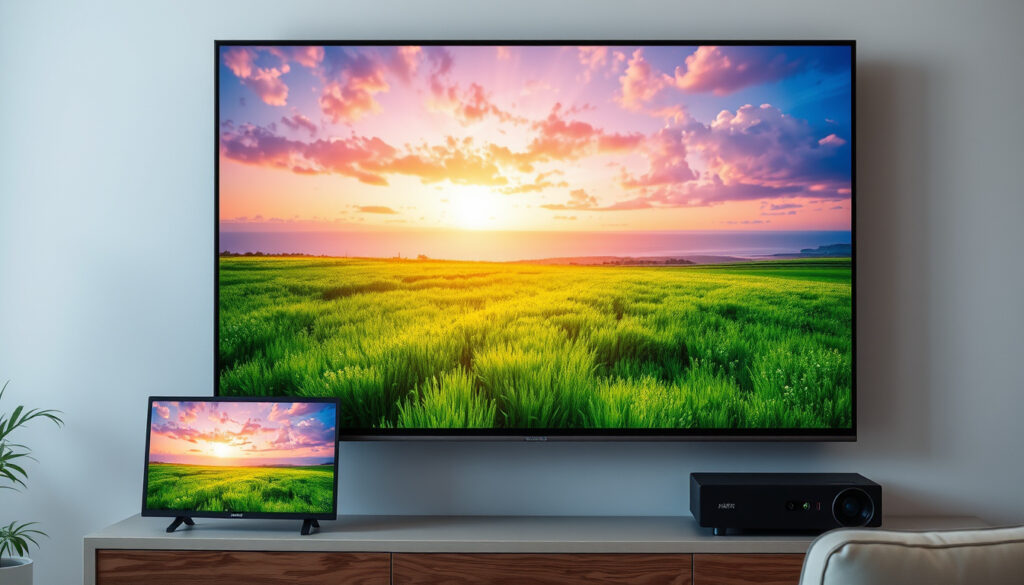
32 Inch 4K TV: Availability, Worth, and Best Alternatives
You’d be forgiven for thinking a 32‑inch 4K TV would be easy to find, but no major manufacturer sells a native 4K TV at 32 inches in 2025. This guide explains why the market is so quiet and what to buy instead for the sharpest picture in a compact space.
Maximum 32‑inch 4K models from major brands: 0 • 32‑inch TVs with 4K upscaling (e.g., Samsung Q60D): 1 • Smallest native 4K TV size commonly available: 40 inches • Approximate pixel density of a 32‑inch 4K display: 138 PPI
Quick snapshot
- No native 32‑inch 4K TV from Samsung, LG, Sony, TCL, or Hisense as of 2025 (DisplayNinja (tech review site))
- Samsung Q60D offers 4K upscaling on a 1080p panel, not native 4K (DisplayNinja (tech review site))
- Whether niche or regional brands will ever release a 32‑inch 4K TV
- If future mini‑LED or micro‑LED could make 4K at 32 inches economically viable
- Early 2010s: first 4K TVs appeared at 40+ inches
- Mid‑2010s: a few 32‑inch 4K panels made for niche monitors, never for TV mass market
- 2020‑2025: 32‑inch TV market remained HD/FHD
- 2025: Samsung Q60D with upscaling, but no native 4K
- Best alternative for sharpness: a 32‑inch 1440p monitor used as a TV (DisplayNinja (tech review site))
- For true 4K: step up to a 40‑inch TV at roughly the same price as a premium 32‑inch (DisplayNinja (tech review site))
- Samsung Q60D remains the only 32‑inch with 4K upscaling (DisplayNinja tech review site) (DisplayNinja (tech review site))
The following table compares the key specs of the Samsung Q60D against a typical 32‑inch 1080p TV.
| Specification | Samsung Q60D (32‑inch) | Typical 32‑inch 1080p TV |
|---|---|---|
| Screen Size | 32 inches | 32 inches |
| Native Resolution | 1920×1080 (upscales to 4K) | 1920×1080 |
| Peak Brightness | 450 nits (DisplayNinja tech review site) | ~250 nits |
| HDR Support | HDR10+ | Basic HDR or none |
| Panel Type | VA | VA or IPS |
| Refresh Rate | 60 Hz | 60 Hz |
| 4K Pixel Density (if native) | 138 PPI (theoretical) | N/A |
| Typical Price | $250–$350 (Which? (UK consumer advice body)) | $150–$250 (Which? UK consumer advice body) |
One pattern across the spec sheet: a 32‑inch screen simply doesn’t have room for the pixel count to make 4K clearly visible at typical seating distances.
Do 32 Inch 4K TVs Exist?
Native vs upscaling 4K on 32‑inch panels
As of 2025, no major TV brand – Samsung, LG, Sony, TCL, Hisense – offers a native 3840×2160 32‑inch TV for the consumer market. The closest you get is the Samsung Q60D, which uses upscaling to simulate 4K from a 1080p panel (DisplayNinja tech review site). That means the TV still receives a 4K signal, but the actual pixels are only a quarter of true 4K.
Which brands have produced 32‑inch 4K models historically?
In the mid‑2010s, a few display manufacturers (LG Display, Sharp) produced small batches of 32‑inch 4K LCD panels, but they were aimed at professional monitors, not televisions (DisplayNinja tech review site). No major TV brand ever mass‑produced a 32‑inch 4K TV. The economics simply didn’t add up.
A 32‑inch 4K TV would carry a premium price but deliver a picture that only a viewer sitting under three feet away could fully appreciate. Most buyers would be paying for unused resolution.
The implication: 32‑inch 4K TVs remain a niche fantasy, not a practical product.
What Is the Smallest Size for a 4K TV?
Common smallest native 4K sizes (40 to 43 inches)
The smallest natively 4K televisions you can buy today start at 40 inches – models like the Samsung UE40DU7170 or Sony X85K 43‑inch. The 40‑inch size has become the entry point because the pixel density (around 110 PPI) provides a visible improvement over 1080p at a normal seating distance of 5–6 feet (Which? UK consumer advice body).
Why 32‑inch 4K panels are rare in the TV market
Two forces are at work: cost and demand. Manufacturing a 4K panel at 32 inches requires extremely fine pixel pitches (∼0.18 mm), raising yield losses and driving up price (DisplayNinja tech review site). Meanwhile, most consumers buying a 32‑inch TV put it in a bedroom or kitchen where they sit 4–8 feet away – a distance at which 1080p already looks sharp. The combination means mass production never took off.
Why Is 4K TV Not Available in 32 Inch?
Manufacturing cost and demand economics
A 32‑inch 4K panel must pack nearly 8.3 million pixels into a diagonal area of 32 inches. The pixel density of 138 PPI is about double that of a 32‑inch 1080p TV (69 PPI). That level of precision increases the cost of the glass, backlight, and driver ICs. According to analysis from Which? UK consumer advice body, at the same price point, a consumer can buy a 40‑ or 43‑inch 4K TV with a far larger screen – so the value proposition for a 32‑inch 4K simply doesn’t exist for most shoppers.
Pixel density diminishing returns below 40 inches
At a normal viewing distance of 4 feet, the human eye can discern about 60 pixels per degree. A 32‑inch 1080p TV at 4 feet yields roughly 48 PPD – already above the threshold for most viewers. To make 4K clearly visible on a 32‑inch screen, you’d need to sit closer than 3 feet (Rtings.com (display testing lab)). That limits practical use cases mainly to desk monitors.
If mini‑LED backlighting or micro‑LED yields cheaper high‑PPI panels, a 32‑inch 4K TV could eventually appear. But as of 2025, the manufacturing math doesn’t work.
The pattern: manufacturing economics and consumer behavior have kept the 32‑inch 4K TV off the market.
Is 4K Noticeable on a 32 Inch TV?
Viewing distance impact on perceived resolution
The difference between 1080p and 4K on a 32‑inch screen is very slight at standard distances. At 5 feet, a viewer with 20/20 vision can barely resolve the extra pixels. At 8 feet, the two resolutions look identical (Rtings.com display testing lab). Only when you sit 2–3 feet away – typical for a computer monitor – does the 4K become noticeably crisper.
Comparison: 1080p vs 4K on a 32‑inch screen
Side by side at a desk, a 32‑inch 4K monitor shows sharper text and finer details in photos or games. But for movie watching from a couch, a 32‑inch 1080p TV delivers essentially the same perceived clarity at a fraction of the cost (DisplayNinja tech review site).
Is It Worth Getting a 32‑Inch 4K TV?
Upsides
- Sharpest possible text and interface if used as a monitor
- Future‑proofed for 4K content at very close viewing distances
- Samsung Q60D’s upscaling improves lower‑resolution content moderately
Downsides
- Pay a premium for resolution you won’t see at normal TV distances
- No native 4K model exists – only upscaling on 1080p panels
- Better value: 40‑inch 4K TV at similar price, or 32‑inch 1440p monitor for sharpness
The trade‑off is clear: unless you plan to sit within arm’s reach, the money spent on 4K upscaling in a 32‑inch TV is better put toward a larger screen or a higher‑resolution monitor. For budget shoppers, the TCL 3‑Series (32S546) is often cited as the best budget 32‑inch TV (YouTube tech reviewer).
Alternatives: 32‑inch 1080p or 1440p monitors for sharpness
For a desk setup, a 32‑inch 2560×1440 (1440p) monitor provides 91 PPI – noticeably sharper than 1080p and still easier to drive than 4K. Many models cost under $300 and include features like higher refresh rates (DisplayNinja tech review site). If you need 4K for photo editing or spreadsheets, a 27‑inch 4K monitor is a more practical choice. For those seeking the ultimate compact OLED experience, the LG OLED32C1 is an option (ScreenGuardian tech news site).
“4K upscaling on 32‑inch is a rarity”
– TechRadar expert (consumer electronics reviewer), on the Samsung Q60D
“At typical TV distances, the difference between 1080p and 4K on a 32‑inch screen is almost imperceptible.”
– Rtings.com analyst (display testing specialist)
The verdict: unless you sit very close, the extra cost of 4K upscaling is wasted.
youtube.com, pcmag.com, nytimes.com, youtube.com, reviewed.com
For those who cannot find a 32-inch 4K TV, exploring the best 32-inch smart TV models can be a practical alternative for smaller spaces.
Frequently asked questions
Can I use a 32‑inch 4K monitor as a TV?
Yes, but most 32‑inch 4K monitors lack a TV tuner, remote control, and smart TV platform. You’ll need an external streaming device. The monitor will look very sharp at close range.
What is the best 32‑inch TV for gaming?
The Samsung Q60D (with 4K upscaling) is a strong choice for console gaming. For PC gaming at high frame rates, a 32‑inch 1440p 144Hz monitor is better (DisplayNinja tech review site).
Is a 32‑inch 4K TV good for a bedroom?
At typical bedroom distances (6–10 feet), you won’t see 4K detail. A 32‑inch 1080p TV works fine and costs less (Which? UK consumer advice body).
What is the price of a 32‑inch 4K TV?
Since no native 4K TV exists at 32 inches, there is no standard price. The Samsung Q60D with upscaling sells for $250–$350 (DisplayNinja tech review site).
Does Samsung make a 32‑inch 4K TV?
Samsung makes the Q60D (32 inches) that can accept a 4K input and upscale it to the 1080p panel. It is not a native 4K screen.
What size 4K TV should I buy for a small room?
If you can fit a 40‑inch TV, buy a 40‑inch 4K. If space is tight, a 32‑inch 1080p TV is the smarter buy. For a desk, a 32‑inch 1440p monitor gives you crisp text without the 4K premium.
Are 32‑inch TVs going to get 4K in the future?
It’s possible once mini‑LED panels become cheap enough, but there is no announced product. For now, the industry is focused on larger screens.
Related reading: TV Refresh Rate Explained: 60Hz vs 120Hz – Which Is Better • Hisense TV Review 2025: Good Brand? Problems & Lifespan
For the U.S. buyer shopping for a small TV, the choice is straightforward: pick a 32‑inch 1080p set from a trusted brand and spend the savings on a soundbar or streaming subscription – the sharpness you gain from 4K at that size simply isn’t worth the premium.
More related posts