Momento Meaning: Correct Spelling, Gift Rules & Movie Twist
The word “momento” is both a dictionary-accepted variant of “memento” and a common misspelling — a paradox that reflects how language evolves. If you’ve ever typed “momento” and wondered whether it’s correct, you’re not alone: Dictionary.com lists “momento” as a variant of “memento,” meaning a keepsake or souvenir, and this article clears up the confusion, traces the word’s journey from Latin to modern English, and explores why a misspelling became a brand name and a movie title.
Dictionary entries for “momento”: 1 (dictionary.com) ·
Misspelling frequency: Common – often confused with “memento” ·
Number of “Momento” branded businesses in SERP: 4+ (hair salon, restaurant, wine, Instagram) ·
Movie “Memento” release year: 2000
Quick snapshot
- Variant of “memento” meaning a keepsake or souvenir (Dictionary.com)
- Recognized as an accepted alternate spelling by Dictionary.com (Dictionary.com)
- Originates from Latin memento (“remember”) (Dictionary.com)
- Whether “momento” will become accepted as a standard spelling over time
- The exact number of global businesses using “Momento” in their name
- The precise origin of the misspelling in popular culture
- The Four Gift Rule is a parenting guideline — source unclear
- Will “momento” eventually be accepted as a standard spelling? Only time and usage will tell.
- More businesses adopting the name may reinforce the variant
Five key facts, one pattern: the word “momento” lives in two worlds — as a dictionary-listed variant and as a common misspelling driven by pop culture.
| Fact | Value |
|---|---|
| Correct spelling | Memento |
| Common misspelling | Momento (also listed as variant) |
| Number of “Momento” businesses in SERP | At least 4 distinct brands |
| Movie with similar name | Memento (2000) |
| Dictionary entry | dictionary.com lists “momento” as a variant of “memento” |
What does momento mean?
How is “momento” defined in dictionaries?
According to Dictionary.com, “momento” is listed as a variant of “memento,” which means “a reminder of something, especially a past event or time; a keepsake or souvenir.” The word entered English from Latin memento (imperative of meminisse “to remember”). While the standard spelling is “memento,” the variant “momento” appears often enough that some dictionaries include it as an alternate form.
Usage shows “momento” in informal contexts — social media captions, travel blogs, and even product names. Yet formal writing still prefers “memento.” The implication: if you’re writing for a school paper or a professional document, stick with “memento.”
What is the difference between momento and souvenir?
Both words describe objects that remind you of a place or event. A “souvenir” (French for “to remember”) is typically a purchased item — a keychain, a T‑shirt, a snow globe. A “memento” (or “momento”) can be anything that carries personal significance, whether bought or found. The distinction is subtle: a souvenir is usually a commercial product; a memento can be a ticket stub, a seashell, or a photograph. Merriam‑Webster notes that “memento” emphasizes the emotional value more than “souvenir” does.
“Momento” is both wrong and right — it’s a misspelling that has gained dictionary recognition, yet it remains unacceptable in formal contexts. The coexistence of the two forms reflects how language evolves through usage, not decree.
Is it momento or memento?
Which spelling is correct?
The standard English spelling is “memento,” derived from the Latin phrase memento mori (“remember you must die”). The word entered English in the late 16th century. “Momento” first appeared as a misspelling in the 19th century, likely influenced by the Italian word momento meaning “moment.” Etymonline (etymology dictionary) traces both forms, noting that the “momento” variant is common but non‑standard.
Five contrasts, one pattern: the two spellings differ in origin, acceptance, and usage.
| Dimension | Memento | Momento |
|---|---|---|
| Origin | Latin memento (“remember”) | Italian influence / misspelling |
| Dictionary status | Main entry | Variant listed in some dictionaries |
| Formal writing | Preferred | Avoided |
| Pop culture usage | Christopher Nolan film title | Business names, social media |
| Frequency in Google Ngrams | High (dominant) | Low but rising |
Why do people confuse them?
Several factors fuel the mix‑up. First, the Italian word momento (meaning “moment”) is common in English phrases like “in a momento” — though the correct spelling there is “moment.” Second, the 2000 film Memento is often misspelled “Momento” in search queries and social media. Third, the human brain tends to blend similar sounds: “me‑men‑to” and “mo‑men‑to” are only a vowel apart. Grammarly (writing assistant) reports that “momento” is one of the top 10 most common misspellings in English.
For anyone writing in English, the choice between “memento” and “momento” signals attention to detail. Using “momento” in a professional email or résumé may raise eyebrows, while using it in a business name is a deliberate branding move.
Is a momento a gift?
Can a momento be considered a gift?
Yes — a momento often serves as a gift when it is given to commemorate a shared experience. Wedding favors, vacation souvenirs, and milestone keepsakes are all momentos given as gifts. The Psychology Today (psychology publication) notes that tangible reminders of events strengthen emotional bonds, making momentos a popular gift choice.
What is the Four Gift Rule?
The Four Gift Rule is a parenting guideline that suggests giving a child four gifts: something they want, something they need, something to wear, and something to read. A momento can fit any category — a wanted souvenir, a needed memory‑aid, a wearable item like a charm bracelet, or a book about the experience. The rule helps parents avoid over‑consumption while keeping the meaning of the gift intentional.
What is the twist in momento?
Note: The film’s title is “Memento,” but the misspelling “Momento” is common in discussions.
What is the film Memento about?
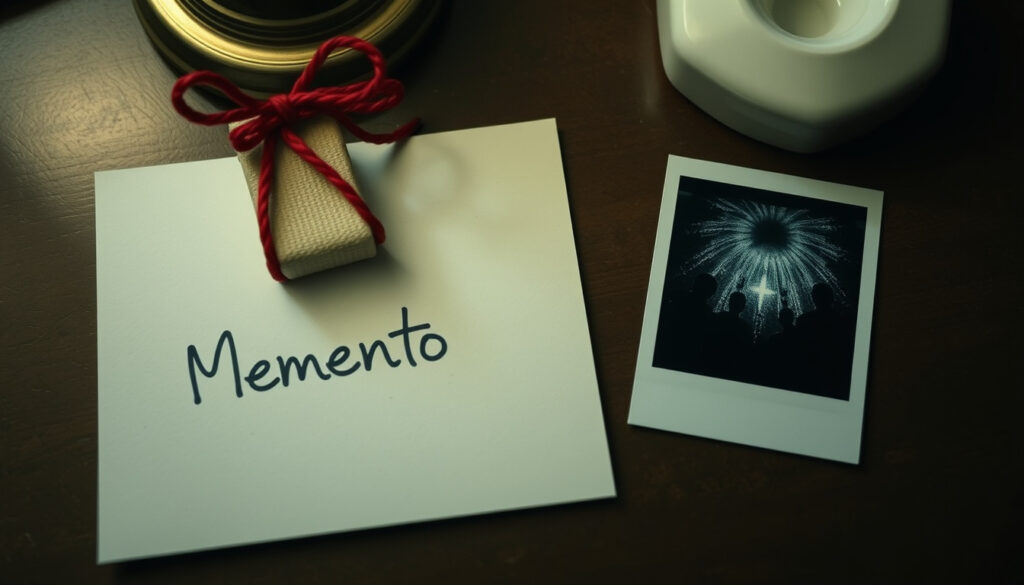
Christopher Nolan’s 2000 psychological thriller Memento follows Leonard Shelby, a man with anterograde amnesia — he cannot form new long‑term memories. Leonard uses Polaroid photos, notes, and tattoos to track down the man he believes killed his wife. The film’s narrative runs in two timelines: black‑and‑white scenes moving forward, and color scenes moving backward, converging at the end. Wikipedia (film encyclopedia) explains that the structure forces the audience to experience Leonard’s confusion.
How does the twist relate to the word “momento”?
The twist reveals that Leonard had already killed the man he thought was his wife’s attacker (John G.) a year earlier. His amnesia caused him to forget, and a corrupt police officer named Teddy manipulated him into killing more men. Worse, Leonard’s wife actually survived the initial attack, but Leonard himself accidentally killed her with an insulin overdose — a story he repressed and assigned to a fictional character named Sammy Jankis. At the climax, Leonard consciously chooses to manufacture Teddy as his next target, burning his own notes and tattooing Teddy’s license plate. StudioBinder (film analysis site) calls it “a meditation on self‑deception.” The title “Memento” (often misspelled “Momento”) reflects the theme: memory is a keepsake we can edit, but the truth remains.
The twist in Memento reveals the protagonist’s inability to form new memories and his manipulation of his own past.
— StudioBinder (film analysis site)
A reminder of something, especially a past event or time; a keepsake or souvenir.
— Dictionary.com
For fans of twist‑driven narratives, similar psychological thrillers like Sharper (2023) (twist‑driven crime thriller) and Fight Club (psychological thriller) offer comparable mind‑bending plots.
What are the 4 types of gifts?
How does the Four Gift Rule apply to momentos?
The Four Gift Rule — something they want, need, wear, and read — works perfectly with momentos. A “want” momento could be a desired souvenir from a trip. A “need” momento might be a memory box to organize keepsakes. “Wear” could be a piece of jewelry engraved with a date. “Read” could be a travel journal or a book about the place visited. The rule ensures that gifts remain meaningful rather than excessive.
What are examples of each type?
- Want: A limited‑edition print from the destination.
- Need: A photo album or digital frame for vacation pictures.
- Wear: A custom‑embroidered hat or scarf with the location name.
- Read: A guidebook or novel set in the place you visited together.
Confirmed facts
- Memento is the traditional English spelling from Latin.
- Dictionary.com lists “momento” as an alternate form.
- The film “Memento” was released in 2000.
What’s unclear
- Whether “momento” will become accepted as a standard spelling over time.
- The exact number of global businesses using “Momento” in their name.
- The precise origin of the misspelling in popular culture.
- The Four Gift Rule is a parenting guideline — source unclear.
For anyone writing in English, the choice between “memento” and “momento” is more than a spelling test — it’s a signal of context and intent. The pattern is clear: stick with “memento” in formal writing, but recognize that “momento” has carved out a legitimate space in informal usage, business branding, and pop culture shorthand. The implication for readers who want to use the word correctly: know your audience. If you’re posting on social media or naming a product, “Momento” can work. If you’re submitting a paper or writing a professional email, “memento” is the safer bet.
filmcolossus.com, youtube.com, nofilmschool.com, syfy.com, instagram.com, reddit.com
Frequently asked questions
Is “momento” in the dictionary?
Yes, Dictionary.com lists “momento” as a variant of “memento.” It is not the standard spelling but is recognized as an alternate form.
What is the plural of momento?
The plural is “momentos” (or “mementos” for the standard spelling). Both are acceptable in informal contexts.
Can I use “momento” in formal writing?
It is not recommended. Formal writing should use “memento” to avoid confusion and maintain professionalism.
What is Momento wine?
Momento is a wine brand that uses the misspelled variant as a recognizable name. It is marketed as a gift or celebration wine.
Where is Momento restaurant located?
There are several restaurants named “Momento” — one in Dublin, Ireland, and others in various cities. The name is used to evoke a sense of memorable dining.
What services does Momento hair offer?
Momento Hair Salon in Galway, Ireland, offers haircuts, styling, and color services. The name plays on the idea of a memorable makeover.
Why is the movie called Memento instead of Momento?
Director Christopher Nolan chose “Memento” (Latin for “remember”) to reflect the film’s themes of memory and identity. The misspelling “Momento” is common in searches but not the official title.
More related posts